



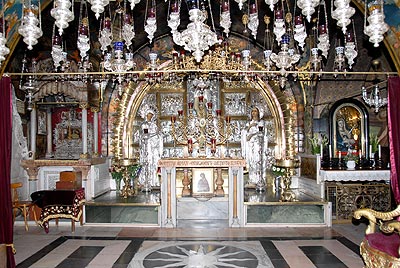
The Authenticity of Golgotha and of the Most Holy Sepulchre *.
The public edifices of the Paschal Chronicle were conjecturally explained (artistically) by Father Germer Durand /1/. He hypothesized that the "tetranymfo" should be the spring of Siloam, which was mentioned by the pilgrim of Bordiga as "quadriporticus", namely, as four arcades. Of course there is the assurance that the Emperor in the area of the Jewish temple built the temple of Capitolian Zeus and erected within it his statue /2/. The pilgrim of the Bordiga (333) says, he saw two statues of Adrian (?).This view was later proved to be wrong but managed to trap even the German professor of Bohn, Krafft, who from the description that was available, concluded that the gate at that place was the work of Adrian. Also, A. Thierry, in a like manner maintained that the two statues were by Adrian /3/.
There are many who believe that the two statues were attributed to Adrian. One of these two, depicts Anthony the Pious, because from the outside of the yard of Haram-ech-Cherif at the right and against the gate on the furthest side of El-Aksa appears an inscription on the wall which forms part of the base of the statue.
TITUS AEL. HADRIANO
ANTONINO AVG. PIO
P.P.PONTIF. AVGVR.
D.D.
This inscription means: "In honour of the Emperor Caesar, Titus Aelius, Adrianus, Antoninus Augustus Pius, Father of the Country, Pontificus, and Prophet by decision of the deputies" /4/.
From the more contemporary researchers, Mommert, maintains the authenticity of Golgotha as follows:
From those contemporaries, many of whom were of course still alive, when approximately ten years after the Crucifixional death of the Lord, the city was extended by the wall of Agrippa and included Golgotha. Some survived the destruction of Jerusalem by Titus in 70AD. Specifically someone named Symeon, son of Cleopa, who ascended the bishopric seat of Jerusalem in 64AD, we know very well that he lived to the age of 129 years and suffered a martyr's death in 108 during the emperor Trajan. So the testimony of the contemporaries of Jesus Christ extends to the first quarter of the second century. It is without doubt that after the expansion of the city and the erection of the so called third wall of Agrippa, the memory of the Holy Places was not extinguished as Golgotha was located close to the so called second wall and close to the gates of the city and the buildings which existed in this place would have made the defense of the city more difficult. Even until the reign of Adrian no edifice was built on Golgotha as concluded from what Adrian had said, namely when he built the edifices there in 135 he did not level any buildings.
It is without doubt that the destruction of Jerusalem by Titus could not blot out the memory of the Holy Places. According to the narration by the Romans, the Christian community of Jerusalem left and settled in Pella, beyond the Jordan River. Epiphanius, Bishop of Cyprus during 367, informs us that after the departure of Titus, the Christian community returned again to its country and settled in the ruins of the city.
Without a doubt is also the fact that in 135 when the Emperor Adrian after quelling the revolt of Bar Koheba, built over the ruins of the ancient Jewish Jerusalem the Roman colony of Aelia, the holy lands of Golgotha and the Most Holy Tomb were well known and the Christians venerated them, for otherwise the idolaters would not have turned their attention to this place and defile it with the erection of the temple of Aphrodite. Also without doubt is the fact that Christians did not forget the Holy Places, even when they could not worship there. The faithful performed their holy worship in Jerusalem, the educated continued to be engaged with the Holy Places as it becomes obvious from the authors Tertullian, Origen, Cyprianus, Athanasius and Jeronymus. But also many skeptic authors agree as possible the rescue of the tradition relating to the holy places until the Great Constantine. For truly if any reference concerning Golgotha had disappeared, then how could the Emperor Constantine write to the Bishop of Jerusalem, Makario to decorate with an edifice the known holy Place? Therefore, the site of Golgotha was well known to all /15/.
From all the research it follows as indisputable, the conclusion that the genuineness of Golgotha and of the Most Holy Sepulchre is as truthful and certain as is the Christian truth, saved by the Church of Jerusalem intact and undefiled.

Magazine New Zion volume 4, 1928
References
*) See Volume 4, 1928, p. 193
- 1) Echos D'Orient 1904 p. 65-71, Revue Biblique 1 p. 369-387. More on the Aelia see Deyling's de Aeliae Capitolinae orig. et historia. Munter's History of the Jewish war under Trajan and Hadrian. This work was translated at the Bibliotheca Sacra of Robinson p.393-455.
- 2) Dion Kassius LXIX, 12
- 3) Saint Jeronymus, translation Nic. I. Stamatiadou, Samos, p. 168
- 4) F. de Saulcy, Jerusalem, Paris 1882 p. 87-88
- 5) Epist. 49 ad Paulin
- 6) The camp of the tenth Legion at Jerusalem and the city of Aelia by W. Wilson in Pal. Exp. Fund 1905, p.138-144.
- 7) Coquerel, Topographie de Jerusalem p. 130-131.
- 8) This turnabout reminds naturally the "he sent away the atheists" of Holy Polycarpus and the power of Origen. At the idolatric temples there was a custom to share branches of palm trees. Origen having been forced to go to a idolatric temple and having given such branches, immediately said: "Come and take not the branch of the idols but the sprout of Christ".
- 9) Ecclesiastic History X, 7.
- 10) Epist. XXXI.
- 11) "Dominus secundum coeli tractum in Venerario passus est, qui erat locus in parte aquilonis".
- 12) F. de Sauley, Jerusalem, Paris 1882. De Sauley Num. de la Terre Sainte p. 374. Palestine Exploration Fund 1903 p. 242.
- 13) Pal. Explor. Fund 1902 p. 67-70.
- 14) Das hellige Land I, 419.
- 15) C. Memmert, Golgotha, 4-10 Booklet New Zion 1914,33






 Login
Login